DISCOVER, UNDERSTAND & EMBRACE SCOPE
Workshop #6: Stages of Multiple Locations Within Your Scope
How to Think, Plan, and Pray for Your Scope
Changing your thinking – When staff (who have been accustomed to ministering and building a movement in one focused location with no target date to finish) now begin to think about launching and developing movements in 10-40 locations, it can be overwhelming and even might feel impossible.
In many ways, this might be how the disciples felt when they looked at a tired and hungry crowd of 5000 and Jesus told them, “You give them something to eat.” Before we even think of strategies, tools, or plans, we must remember that “Jesus asks us to do what we can’t do with resources we don’t have, so that we can learn to do what only He can do with resources that only He can provide.” Remember: He is working and He desires that we share with Him in the work He has prepared to do.
We could never even begin to dream of reaching 10-40 universities in a short period of time if we did not believe that He is already at work preparing the people and resources for movements! With God, anything is possible, even the ‘impossible’ is possible!
How does ‘changing your thinking’ free you up to step out in faith to trust God to use you and your team to see multiple universities in multiple locations reached?
Developing your plan keeping in mind the Stages in Movement Development
Thinking about your scope in terms of “stages” can help you focus your work in each location as well as help you trust God for each school and keep you from being overwhelmed in the sheer size of it all.
As you begin to engage and discover what God is doing and the resources He has provided, it helps to think of universities in terms of their stage or ‘level of development.’ Thinking by stages helps keep your next steps and prayer for each university very specific and focused. Your task is to help or coach each university (Key Volunteers) move to the next stage of movement development.
Your first priority is simply to see each university to go forward to the next stage of development.
How to plan stages of movement development in universities where the catalytic approach is used.
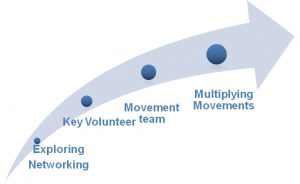 Catalytic movement development basically has 4 stages. We will enter into detailed treatment of each of these stages later in the training, but for now we want to introduce you to the idea of stages in developing a movement and help you apply it to the big picture of your scope.
The four stages of a Catalytic movement:
1) Exploring and Networking: An individual or a team targets a new location or context; then through prayer, vision casting, networking, and evangelism they take responsibility for trusting God to find or reach a few Key Volunteers who will build the movement in the new location. (we will discuss what a Key Volunteer is later in the training).
2) Aligned Key Volunteers: God raises up one or a few Key Volunteers who commit to reach their campus and are coached and equipped in sharing their faith, beginning to do basic follow up, and helping new believers grow.
3) Key Volunteer Team: Those Key Volunteers develop a team of leaders that owns the planning and building of the local movement. (They continue to be coached and equipped to build the movement.)
4) Multiplying New Movements and Lifetime Laborers: The original Key Volunteer movement target new areas and launch and multiply new movements.
From Exploring/Networking to Find Key Volunteers → Aligning Key Volunteers → Building Teams/Movement → Multiplying Movements
Later we will talk more about how to work in multiple locations helping each location take the “next step”, keeping in mind that not all universities will be in the same stage at the same time or will move forward at the same pace. This is part of the ‘messiness’ (and the fun challenge) of the Catalytic approach.
Having your scope represented can be visionary, but also overwhelming. In the next section, you’ll focus on praying for your scope.